Thursday, 13 October 2022

Cls 10 Sci Chptr 13 Slusn

Class 10 Science

Chapter 13 Magnetic effect of Electric current

Solutions 

Page:224

1. Why does a compass needle get deflected when brought near a bar magnet?

Ans:

The needle of a compass is a small magnet and its magnetic field lines interact with that of the bar magnet. Hence, a compass needle gets deflected.

Page Number: 228

1. Draw magnetic field lines around a bar magnet.

Ans:


2. List the properties of magnetic lines of force.
Ans:
> Magnetic field lines do not intersect with each other.
> They emerge from the North Pole and terminate at the South Pole.
> Inside the magnet, the direction of the field lines is from the South Pole to the North Pole.
> Magnetic field lines are curved loop.

3. Why don’t two magnetic lines of force intersect each other ?
Ans:
If two magnetic field lines intersect then at the point of intersection the compass needle shows two different directions, which is not possible, hence they do not intersect with each other.

Page Number: 229 – 230

1. Consider a circular loop of wire lying on the plane of the table. Let the current pass through the loop clockwise. Apply the right hand rule to find out the direction of the magnetic field inside and outside the loop.
Ans:
Inside the loop = Pierce inside the tableOutside the loop = Appear to emerge out from the tableFor downward direction of current flowing in the circular loop, the direction of magnetic field lines will be as if they are emerging from the table outside the loop and merging in the table inside the loop. Similarly, for upward direction of current flowing in the circular loop, the direction of magnetic field lines will be as if they are emerging from the table outside the loop and merging in the table inside the loop, as shown in the given figure.
2. The magnetic field in a given region is uniform. Draw a diagram to represent it.
Ans:

3. Choose the correct option.
The magnetic field inside a long straight solenoid-carrying current
(i) is zero
(ii) decreases as we move towards its end
(iii) increases as we move towards its end
(iv) is the same at all points
Ans:
(iv) Is the same at all points.

Page Number: 231 – 232

1. Which of the following property of a proton can change while it moves freely in a magnetic field. (There may be more than one correct answer.)
(i) Mass
(ii) Speed
(iii) Velocity
(iv) Momentum
Ans:
The correct options are (iii) velocity, (iv) momentum.

2. In Activity 13.7 how do we think the displacement of rod AB will be affected if (i) current in rod AB is increased (ii) a stronger horse-shoe magnet is used; and (iii) length of the rod AB is increasedif
Ans:
the strength of the magnetic force exerted on the rod AB and its displacement will increase if
> The current in rod AB is increased
> Stronger horse shoe magnet is used
> When the length of the rod AB increases

3. A positively-charged particle (alpha particle) projected towards west is deflected towards north by a magnetic field.
The direction of magnetic field is :
(i) towards south
(ii) towards east
(iii) downward
(iv) upward
Ans:
(iv) Upward.

Page Number: 233

1. State Fleming’s left hand rule. 
Ans:
Fleming’s left hand rule : Stretch the first finger, the middle finger and the thumb of your left hand mutually perpendicular to each other in such a way that the first finger represents the direction of the magnetic field, the middle finger represents the direction of the current in the conductor, then the thumb will represent the direction of motion of the conductor.

2. What is the principle of an electric motor ? 
Ans:
A motor works on the principle of magnetic effect of current. When a rectangular coil is placed in a magnetic field and current is passed through it, a force acts on the coil which rotates it continuously.

3. What is the role of the split ring in an electric motor ?
Ans:
The split ring reverses the direction of current in the armature coil after every half rotation.

Page Number: 236

1. Explain different ways to induce current in a coil.
Ans: 
Different ways to induce current in a coil are :
> moving a magnet towards or away from the coil or vice-versa, and
> changing current in the neighbouring coil.

Page Number: 237

1. State the principle of an electric generator.
Ans:
Electric generator works on the principle of electromagnetic induction. Electricity is generated by rotating a coil inside magnetic field.

2.'Name some sources of direct current.
Ans:
dry cells, button cells, DC generator

3. Which sources produce alternating current ?
Ans:
Power plants and AC generators

4. Choose the correct option : A rectangular coil of copper wires is rotated in a magnetic field. The direction of the induced current changes once in each:
(i) two revolution
(ii) one revolution
(iii) half revolution
(iv) one-fourth revolution
Ans:
(iii) Half revolution.

Page Number: 238

1. Name two safety measures commonly used in electric circuits and appliances.
Ans:
(i) Earthing and
(ii) Electric fuse.

2. An electric oven of 2 kW power rating is operated in a domestic electric circuit (220 V) that has a current rating of 5 A. What result do you expect ? Explain.
Ans:
The electric oven draws a current given by

The current drawn by the electric oven is 9.09 A which exceeds the safe limit of the circuit. This causes the fuse to melt and break the circuit.

3. What precaution should be taken to avoid the overloading of domestic electric circuits?
Ans:
> Connecting too many devices to a single socket should be avoided
> Using too many appliances at the same time should be avoided
> Faulty appliances should not be connected to the circuit

Exercises Questions 

1. Which of the following correctly describes the magnetic field near a long straight wire ?
(i) the field consists of straight lines perpendicular to the wire
(ii) the field consists of straight lines parallel to the wire
(iii) the field consists of radial lines originating from the wire
(iv) the field consists of concentric circles centred on the wire
Ans:
(iv) The field consists of concentric circles centred on the wire

2. The phenomenon of electromagnetic induction is
(i) the process of charging a body
(ii) the process of generating magnetic field due to a current passing through a coil
(iii) producing induced current in a coil due to relative motion between a magnet and the coil
(iv) the process of rotating a coil of an electric motor
Ans:
(iii) Producing induced current in a coil due to relative motion between a magnet and the coil

3. The device used for producing electric current is called a
(i) generator
(ii) galvanometer
(iii) ammeter
(iv) motor
Ans:
(i) Generator.

4. The essential difference between an AC generator and a DC generator is that
(i) AC generator has an electromagnet while a DC generator has permanent magnet
(ii) DC generator will generate a higher voltage
(iii) AC generator will generate a higher voltage
(iv) AC generator has slip rings while the DC generator has a commutator
Ans:
(iv) AC generator has slip rings while the DC generator has a commutator

5. At the time of short circuit, the current in the circuit
(i) reduces substantially
(ii) does not change
(iii) increases heavily
(iv) varies continuously
Ans:
(iii) Increases heavily.

6. State whether the following statements are True or False.
(i) An electric motor converts mechanical energy into electrical energy.
(ii) An electric generator works on the principle of electromagnetic induction.
(iii) The field at the centre a long circular coil carrying current will be parallel straight lines.
(iv) A wire with a green insulation is usually the live wire of an electric supply.
Ans:
(i) False
(ii) True
(iii) True
(iv) False.

7. List three sources of magnetic fields.
Ans:
(i) Current carrying conductor
(ii) Electromagnets
(iii) Permanent magnets

8. How does a solenoid behave like a magnet ? Can you determine the north and south poles of a current-carrying solenoid with the help of a bar magnet? Explain.
Ans:
A solenoid behaves like a magnet in the following ways.
> The magnetic field produced by a current carrying solenoid is very much similar to that of a bar magnet.
> Like a bar magnet, one end of the solenoid has N-polarity while the other end has S-polarity.
To determine the north and south poles, we bring N-pole of the bar magnet near one end of the solenoid. If there is an attraction, then that end of the solenoid has south polarity and the other has north polarity. If there is a repulsion, then that end of the solenoid has north polarity and the other end has south polarity because similar poles repel each other.

9. When is the force experienced by a current–carrying conductor placed in a magnetic field largest?
Ans:
When the direction of the current is perpendicular to the direction of the magnetic field is when the force experienced is the largest.

10. Imagine that you are sitting in a chamber with your back to one wall. An electron beam, moving horizontally from back wall towards the front wall, is deflected by a strong magnetic field to your right side. What is the direction of magnetic field ?
Ans:
The direction of the magnetic field is vertically downwards.

11. Draw a labelled diagram of an electric motor. Explain its principle and working. What is the function of a split ring in an electric motor ?

Ans:

Principle: It works on the principle of the magnetic effect of current. A current-carrying coil rotates in a magnetic field.

Working: When current starts to flow in the coil ABCD, the direction of current  from A to B  and from C to D. The direction of force exerted on the coil can be found through Fleming’s left hand law.

According to this law, it is found that the force exerted on the part AB, pushes the coil downwards. While the force exerted on the part CD pushes it upwards. that rotates the coil in anticlockwise direction.

After half rotation, the polarity of the commutator also changes,  now the force exerts downwards on the arm AB and upwards on the arm CD. This process is repeated again and again and the coil rotate continuously.

The split rings help to reverse the direction of current in the circuit. These are called the commutator.

12. Name some devices in which electric motors are used.

Ans:

  • Electric fans
  • Water pumps
  • Mixers
  • Washing machines
13. A coil of insulated copper wire is connected to a galvanometer. What will happen if a bar magnet is (t) pushed into the coil (ii) withdrawn from inside the coil (iii) held stationary inside the coil ? 
Ans:
(i) The needle of the galvanometer shows a momentary deflection in a particular direction.
(ii) The needle of the galvanometer shows a momentarily in the opposite direction.
(iii) The needle of the galvanometer shows no deflection.

14. Two circular coils A and B are placed closed to each other. If the current in the coil A is changed, will some current be induced in the coil B? Give reason.
Ans:
When the current in coil A changes, the magnetic field associated with it also changes. As a result the magnetic field around coil B undergoes change. The change in the magnetic field of coil B induces current in it.

15. State the rule to determine the direction of a (i) magnetic field produced around a straight conductor-carrying current (it) force experienced by a current-carrying straight conductor placed in a magnetic field which is perpendicular to it, and (in) current induced in a coil due to its rotation in a magnetic field.
Ans:
(i) Right hand thumb rule : If the current carrying conductor is held in the right hand such that the thumb points in the direction of the current, then the direction of the curl of the fingers will give the direction of the magnetic field.
(ii) Fleming’s left hand rule : Stretch the forefinger, the central finger and the thumb of the left hand mutually perpendicular to each other. If the forefinger points in the direction of the magnetic field, the middle finger in the direction of current, then the thumb points in the direction of force in the conductor.
(iii) Fleming’s right hand rule : Stretch the thumb, forefinger and the central finger of the right hand mutually perpendicular to each other. If the forefinger points in the direction of magnetic field, thumb in the direction of motion of the conductor, then the middle finger points in the direction of current induced in the conductor.

16. Explain the underlying principle and working of an electric generator by drawing a labelled diagram. What is the function of brushes ?

Ans:

Principle: The working principle of the electric generator is the electromagnetic induction. It generates electricity by rotating a coil in the magnetic field.

Working : When the armature coil ABCD rotates in a magnetic field produced by the permanent magnets, it cuts through the magnetic lines of force.

Due to the rotation of armature coil, the associated magnetic field changes and an induced electromagnetic force is produced in it. The direction of this induced electromotive force or current can be determined by using Fleming’s right hand rule.

In first half cycle the current flows in one direction by brush B1 and in second it flows in opposite direction by brush B2. This process continues. So the current produced is alternating in nature.

Functions of Brushes : Brushes in contact with rings provide the current for external use

17. When does an electric short circuit occur ?

Ans:

short-circuit occurs when live and neutral wire come in direct contact with each other without any resistance. The resistance of the circuit becomes zero and excessive current starts to flow through it.

18. What is the function of an earth wire? Why is it necessary to earth metallic appliances?

Ans:

> The metallic body of electric appliances is earthed by means of earth wire. Any leakage of electric wire is transferred to the ground by means of earth wire.

> This prevents any electric shock to the user.


Sunday, 9 October 2022

Cls 10 sci chp 4 soln

 Class 10 Science 

 Chapter 4 Carbon and its Compounds 

 Solutions 

Intext Questions 

Page Number: 61

1. What would be the electron dot structure of carbon dioxide which has the formula CO2 ?

Ans:

2. What would be electron dot structure of sulphur which is made up of eight atoms of sulphur.

Ans:


Page Number: 68 – 69

1. How many structural isomers can you draw for pentane ?

Ans:

Three, these are n-pentane, iso-pentane and neo-pentane.

2. What are the two properties of carbon which lead to the huge number of carbon compounds we see around us ?

Ans:

(i) Tetravalency

(ii) Catenation.

3.What will be the formula and electron dot structure of cyclopentane ?

Ans:

The molecular formula of cyclopentane is C5 H10 .

The electron dot structure of cyclopentane is.

4. Draw the structures for the following compounds :

(i) Ethanoic acid

(ii) Bromopentane

(iii) Butanone

(iv) Hexanal

Ans:

(i) Ethanoic acid (CH3COOH)


(ii) Bromopentane (C5H11Br)


(iii) Butanone (CH3 — CH2 — COCH3)


(iv) Hexanal (C5H11CHO)


5. How would you name the following compounds ?

Ans:

(i) Bromoethane

(ii) Methanal

(iii) 1 – Hexyne

Page Number: 71

1. Why is the conversion of ethanol to ethanoic acid an oxidation reaction ?

Ans:

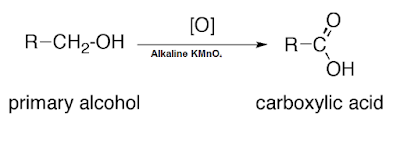
Conversion of ethanol into ethanoic acid is an oxidation reaction because addition of oxygen to a substance is called oxidation. Here, oxygen is added to ethanol by oxidising agent like alkaline potassium permanganate or acidified potassium dichromate and it is converted into acid.


2. A mixture of oxygen and ethyne is burnt for welding. Can you tell why a mixture of ethyne and air is not used ?

Ans:

A mixture of ethyne and air is not used for welding because burning of ethyne in air produces a sooty flame due to incomplete combustion, which is not enough to melt metals for welding.

Page Number: 74

1. How would you distinguish experimentally between an alcohol and a carboxylic acid ?

Ans:

Acid reacts with carbonate and hydrogen carbonate to evolve CO2 gas that turns lime water milky.

2CH3COOH + Na2CO3 → 2CH3COONa + H2O + CO2

Alcohols, on the other hand, do not react with carbonates and hydrogen carbonates.

2. What are oxidising agents ?

Ans:

Oxidising agents are the substances which give oxygen to another substances or which remove hydrogen from a substance.

Page Number: 76

1. Would you be able to check if water is hard by using a detergent ?

Ans:

Detergent gives lather with hard and soft water both, while a soap gives lather with soft water only. Thus, it is not possible to check if water is hard; by using a detergent.

2. People use a variety of methods to wash clothes. Usually after adding the soap, they ‘beat’ the clothes on a stone, or beat it with a paddle, scrub with a brush or the mixture is agitated in a washing machine. Why is agitation necessary to get clean clothes ?

Ans:

It is necessary to agitate to get clean clothes because the soap micelles which entrap oily or greasy particles on the surface of dirty cloth have to be removed from its surface.


Exercise questions

1. Ethane, with the molecular formula C2H6 has

(a) 6 covalent bonds

(b) 7 covalent bonds

c) 8 covalent bonds

(d) 9 covalent bonds

Ans: (b) 7 covalent bonds.

2. Butanone is a four-carbon compound with the functional group

(a) carboxylic acid

(b) aldehyde

c) ketone

(d) alcohol

Ans: c) Ketone.

3. While cooking, if the bottom of the vessel is getting blackened on the outside, it means that

(a) the food is not cooked completely.

(b) the fuel is not burning completely.

c) the fuel is wet.

(d) the fuel is burning completely.

Ans: (b) The fuel is not burning completely.

4. Explain the nature of the covalent bond using the bond formation in CH3Cl.

Ans:

Carbon has four valence electrons. It shares 1 electron each with 3 hydrogen atoms and 1 electron with chlorine. The bond between C and Cl atoms is covalent but due to higher value of electro-negativity of Cl, the C–Cl bond is polar in nature.

5. Draw the electron dot structures for

(a) ethanoic acid

(b) propanone

c) H2S

(d) F2.

Ans:

6. What is a homologous series ? Explain with an example.

Ans:

A homologous series is a group of organic compounds having in which the successive compounds differ by -CH2 group.

For example, methane, ethane, propane, butane, etc. are all part of the alkane homologous series. The general formula of this series is CnH2n+2.

Methane CH4

Ethane CH3CH3

Propane CH3CH2CH3

Butane CH3­CH2CH2CH3

It can be noticed that there is a difference of -CH2 unit between each successive compound.

7. How can ethanol and ethanoic acid he differentiated on the basis of their physical and chemical properties ?

Ans:


8. Why does micelle formation take place when soap is added to water ? Will a micell be formed in other solvents such as ethanol also ?

Ans:

Micelle formation takes place when soap is added to water because the hydrocarbon chains of soap molecules are hydrophobic (water repelling) which are insoluble in water, but the ionic ends of soap molecules are hydrophilic (water attracting) and hence soluble in water.

Such micelle formation will not be possible in other solvents like ethanol in which sodium salt of fatty acids do not dissolve.

9. Why are carbon and its compounds used as fuels for most applications ?

Ans:

Carbon and its compounds give a large amount of heat per unit weight. therefore, used as fuels for most applications.

10. Explain the formation of scum when hard water is treated with soap.

Ans:

Hard water contains salts of calcium and magnesium. Calcium and magnesium on reacting with soap form insoluble precipitate called scum. The scum formation lessens the cleansing property of soaps in hard water.

11. What change will you observe if you test soap with litmus paper (red and blue)?

Ans:

Red litmus will turn blue because soap is alkaline in nature. Blue litmus remains blue in soap solution.

12. What is hydrogenation ? What is its industrial application ?

Ans:

The addition of hydrogen to an unsaturated hydrocarbon to obtain a saturated hydro-carbon is called hydrogenation. The process of hydrogenation takes place in the presence of nickel (Ni) or palladium (Pd) metals as catalyst.

Application : The process of hydrogenation has an important industrial application. It is used to prepare vegetable ghee (or vanaspati ghee) from vegetable oils.

13. Which of the following hydrocarbons undergo addition reactions :

C2H6, C3H8, C3H6, C2H2 and CH4

Ans:

Addition reactions take place only in unsaturated hydrocarbons. So addition reaction take place only in C3H6 and C2H2.

14. Give a test that can be used to differentiate chemically between butter and cooking oil.

Ans:

we can distinguish chemically between a cooking oil and butter by the bromine water. Add bromine water to a little of cooking oil and butter taken in separate test-tubes.

> Cooking oil decolourises bromine water showing that it is an unsaturated compound.

> Butter does not decolourise bromine water showing that it is a saturated compound.

15. Explain the mechanism of the cleaning action of soaps.

Ans:

> The molecules of soap are sodium or potassium salts of long chain carboxylic acids.

> The ionic end of soap interacts with water while the carbon chain interacts with oil.

> The soap molecules thus form structure called micells. This forms an emulsion in water.

> The soap micelles thus helps in pulling out the dirt in water and we can wash our clothes clean.


Cls 10 Sci act soln chp 4

 Class 10 Science 

 Chapter 4 Carbon and its Compounds 

 Activity Solutions 

Activity 4.1 

Brief procedure:

Activity 4.1 asks us to list the materials we use in daily life and classify them by their source.

 Answer:

In daily life, we see and utilise many materials. We can classify them in many ways like shape and size, composition, colour etc. Based on the composition of the material, we can classify materials like metals, plant products, soil and clay products and so on. Below is the classification of material as metals, clay products and others.

Things made of metal: glass, plate, compass box, pen, bottle, mobile phone, watch, key-ring, fridge, cooler

Items made of glass/clay: Glass, bowl, pitcher, window, glass door.

Example of others: Book, pen, bottle, glass, tiffin box, cooler, washing machine, bag, cloth, wood door, polythene bag etc

Vegetables we eat are organic compounds.

Explanation: 

We use a variety of materials in our daily life. A significant number of objects consist of organic compounds. For example, all plant products like fruits, seeds, paper; all soil products like clay pot; all polythene products like plastic, rubber etc. are organic compounds. This vast presence of organic compound signifies its importance in our life.

Activity 4.2

Brief procedure:

Activity 4.2 asks us to observe the difference in formulae and molecular masses of various alcohol.

Observation:

Name: Chemical formula: Difference; Molecular weight: Difference

Methanol: CH3OH —-         32 —–

Ethanol: C2H5OH -CH2      46        14

Propanol: C3H7OH -CH2     60     14

Butanol: C4H9OH -CH2        74     14

Explanation: 

Carbon contains four electrons in its valance shell. It needs 4 extra valence electrons to complete the octet. It combines with various other molecules like oxygen, nitrogen, hydrogen but also reacts with other carbon atoms as well. We call such property as polymerisation tendency. Here, a carbon atom attaches to another carbon atom and elongates the chain. The various compounds formed show similar property and gradual change (increase or decrease) in the property, e.g. Boling point, melting point, solubility, polarity. We call such groups as homologous series.

Methanol, ethanol, propanol, butanol etc. are similar in structure and molecular weight increases by 14amu (Atomic Mass Unit). Here Melting point and boiling point also increase with the number of carbon atoms. They all show the polar property due to the presence of polar -OH(hydroxy group). With an increase in the bulkiness of carbon atom, higher alcohols are less polar.

We use such a tendency to predict the behaviour of the molecule.

Similarly, the property of other functional groups like Amide (CONH2), Carboxylic acid (COOH), Primary, secondary, and tertiary Amines (NH) etc. also depend on the number of carbon atoms.

Inference/conclusion: molecules of a homologous series show similar physical and chemical property.

Activity 4.3 

Brief procedure:

Activity 4.3 asks us to burn various organic compounds and observe the flame.

Observation:

Naphthalene and camphor burn with yellow flame while alcohol burn with a blue flame.

Explanation:

Structure of Naphthalene, Ethanol, and Camphor

We use Naphthalene to preserve cloth from microorganisms. It is an unsaturated compound with multiple double bonds. It burns in air and gives yellow smoke.

Alcohol and camphor are saturated hydrocarbon. Alcohol burns with a blue flame which show complete combustion. Camphor burn with a yellow flame.

Colour of the flame depends on the amount of carbon relative to others. The higher proportional carbon atom results in incomplete combustion. Naphthalene has five double bonds so it has more carbon atoms; camphor has one cyclic ring so lesser than naphthalene; while ethanol is completely saturated carbon compound without a cyclic ring. As a result, naphthalene has a sooty yellow flame while ethanol has a blue flame.

Activity 4.4

Brief procedure:

Activity 4.4 asks us to examine the flame colour with changing the position of the knob of the Bunsen burner.

A Bunsen burner.

Observation: 

The flame changes its colour from yellow to blue with the change in position of the knob.

Explanation: 

Bunsen burner is a simple burner which we use in a laboratory.

It consists of a gas pipe, a metal base, barrel and an adjustable collar.

At the bottom of the flame pipe, there are two small holes for air. A small knob, Collar is present near the hole to adjust the air inflow.

If the knob is completely open flame is blue and of smaller height. While if we close the knob the flame height increase with a yellow flame.

Gas is the common LPG gas that we use in daily life. LPG (liquified petroleum gas) is a carbon compound. It is butane the fourth homologous of the simplest carbon compound, methane. Under the insufficient quantity of air, it burns with a yellow flame.

Activity 4.5

Brief procedure:

Activity 4.5 asks us to add alkaline potassium permanganate in warm ethanol and observe the change in colour.

Observation: 

Initially red colour of potassium permanganate disappear. On adding more potassium permanganate red colour prevail.

Explanation:

Potassium permanganate is a strong oxidizing agent. It oxidizes alcohol to acids and reduces itself to manganese dioxide. Potassium permanganate solution is red in colour. Initially, when we add potassium permanganate all potassium permanganate is used up in the reaction. After completion of the reaction, there is no more ethanol in the solution. Adding more potassium permanganate after this endpoint makes the solution red.

Why we use a water bath?

Alcohol is a highly inflammable substance. Heating it directly may lead to an explosion. A water bath is a beaker filled with water. We add the alcohol in a test tube and place it in a beaker. It warms the solution without catching fire.

Activity 4.6

Brief procedure:

Activity 4.6 asks us to add a few pieces of sodium metal to an ethanol solution and test for the gas evolved.

Observation: 

Ethanol reacts with sodium to form sodium ethoxide. This salt is colourless and soluble in water. Hydrogen gas evolves during the process which we check by bringing a flame to the test tube.

2C2H5OH(aq) + 2Na(s) —–> 2C2H5ONa (aq)+ H2(g)

Activity 4.7 

Brief procedure:

Activity 4.7 asks us to compare the PH of dilute acetic acid and dilute Hydrochloric acid using litmus paper and universal paper.

Observation: 


Acetic acid is a weak acid. Its PH range is 2 to 4. A typical,1M solution of acetic acid has a PH of 2.4. So on litmus paper, it shows a red-yellow colour. See activity 2.11.

Hydrochloric acid is a strong acid. It’s 0.1M solution has a PH of 1. It shows an utterly red colour with litmus paper.

Universal PH indicator: 

Universal PH indicator


A universal indicator is a mixture of various PH indicators which give sharp colour at different PH.

Here HCL gives red colour and acetic acid gives yellow.

Activity 4.8

Brief procedure:

Activity 4.8 asks us to react glacial acetic acid with ethanol in the presence of acid and observe the smell.

Observation:

We observe a fruity smell from the solution.

Explanation:

Ethanol reacts with acetic acid in the presence of concentrated sulphuric acid and forms ester. Ester has a characteristic fruity or pleasant smell, which we can detect by the smell.

This is a reversible reaction, ethyl acetate produced is dilute after formation to avoid the backward reaction. Addition of bases like sodium hydroxide also reverses the reaction.

Activity 4.8

Brief procedure:

Activity 4.8 asks us to see if there is a reaction between ethanoic acid and carbonates or hydrogen carbonate like Activity 2.5.

Observation: 

Similar to inorganic acids, ethanoic acid reacts with sodium carbonate and hydrogen carbonates. Evolved gas turns the lime water solution milky.

Explanation:

Carboxylic acids react with carbonates and hydrogen carbonate in the same fashion of inorganic acids and form respective salts. The only difference is the speed of the reaction. Here reaction takes place slowly.

Here sodium metal replaces the most polar hydrogen atom and forms the salt. Carbon dioxide gas evolves which turns the lime water milky.

Activity 4.10 

Brief procedure:

Activity 4.10 asks us to test the shake mixture of oil and water with soap and compare it with plain water and oil.

Observation: 

The mixture of oil and water becomes cloudy with soap while oil separates and form a layer with plain water.

After some time the oil separates from both the solution. But it takes a longer duration for a cloudy solution.

Micelles formation by soap and detergent with fats.

Explanation:

Water is a polar compound. A polar substance like salt forms bond with polar hydrogen and hydroxide molecules of water. This polar nature makes salt soluble in water.

Oil is a non-polar compound. It does not form bonds with water molecules. As a result, oil does not dissolve in water. Instead, they start floating on the surface of the water as they are lighter than water.

Soaps are metal salts of long chain fatty acid. It’s one end is polar (Na+) while another end is non-polar. Polar end forms bonding with the water molecule and non-polar end forms bonding with oil molecules. This form the suspension of oil in water. As a result, the solution becomes cloudy. We call this process micelle formation

Application in daily life:

Dirt in our clothes is mainly oily substances. Soap or surf suspend the dirt between water and cloth. When we agitate this solution dirt passes out from the cloth, and we get a clean cloth.

Application in biological processes: 

Pancreatic lipase is a water-soluble enzyme. It can not work on the separate layer of the long chain of the fatty acid of oils. Bile salt from liver suspends the fatty acid into the water to facilitate the action of lipase enzyme. We call this emulsification of fats. You will read this in detail in chapter 6 life processes.

Activity 4.11 

Brief procedure:

Activity 4.11 asks us to check the amount of foam produced by soap in hard water and compare it with foam produced by soap in distilled water.

Observation:

We see more amount of foam in soap with distilled water.

Explanation:

Hard water contains some amount of hydrogencarbonates, sulphates, and chlorides of calcium and magnesium. These salts displace sodium from the soap and form fatty acid of magnesium and calcium. These salts are insoluble and deposit on the bottom as scum. As a result, less soap is available to form the foam

Hard water reaction with soap.

Activity 4.12 

Brief procedure:

Activity 4.12 asks us to compare the foam produced by a soap with hard water and by a detergent with hard water.

Observation:

There is more foam production with detergent.

Explanation:

Soaps are sodium salts of naturally occurring fatty acids like palmitic acid, stearic acid etc. We prepare them by the saponification of natural oils like coconut oil, butter, olive oil with salt. They react with calcium and magnesium ions present in hard water and form an insoluble precipitate. This process reduces the quantity of soap available. Thus soap forms less foam.

Hard water reaction with soap.


Detergents are chemically synthesised compounds also known as cleansing agents. They generally consist of the sodium salt of sulphonic acid or ammonium salt with bromine and chloride ions. These do not react with ions present in hard water. As a result, there is a lesser influence of hard water on foam formation. As a result, we see more foam production with detergents than soaps.