Thursday, 8 September 2022

Class 9 Science Chapter 9 Force and Lows of motion


Class 9 Science

Chapter 9 Force and Lows of motion

Introduction

→ Force: It is the force that enables us to do any work. To do anything, either we pull or push the object. Therefore, pull or push is called force.

Example, to open a door, either we push or pull it. A drawer is pulled to open and pushed to close.

Effect of Force

→ Force can make a stationary body in moving.

For example: a football can be set to move by kicking it i.e. by applying a force.

→ Force can stop a moving body.

For example, by applying brakes, a running cycle or a running vehicle can be stopped


→ Force can change the direction of a moving object.

For example: by applying force i.e. by moving handle, the direction of a running bicycle can be changed. Similarly by moving steering, the direction of a running vehicle is changed.

→ Force can change the shape and size of an object.

For example: by hammering, a block of metal can be turned into a thin sheet. By hammering, a stone can be broken into pieces.

• Forces are mainly of two types:

(i) Balanced forces

(ii) Unbalanced forces

Balanced Forces

→ If the resultant of applied forces is equal to zero, it is called balanced forces.

Example: In the tug of war if both the team apply similar magnitude of forces in opposite directions, rope does not move in either side.This happens because of balanced forces in which resultant of applied forces become zero.


→ Balanced forces do not cause any change of state of an object. Balanced forces are equal in magnitude and opposite in direction.
→ Balanced forces can change the shape and size of an object.
For example: When forces are applied from both sides over a balloon, the size and shape of balloon is changed.
Unbalanced Forces
→ If the resultant of applied forces are greater than zero, the forces are called unbalanced forces.
→ An object in rest can be moved because of applying unbalanced forces.
• Unbalanced forces can do the following:
→ Move a stationary object
→ Increase the speed of a moving object
→ Decrease the speed of a moving object
→ Stop a moving object
→ Change the shape and size of an object

Laws of Motion
• Galileo Galilei: Galileo first of all said that object move with a constant speed when no foces act on them.
→ This means if an object is moving on a frictionless path and no other force is acting upon it, the object would be moving forever. That is, there is no unbalanced force working on the object.
→ But practically it is not possible for any object. Because to attain the condition of zero, unbalanced force is impossible.
→ Force of friction, force of air and many other forces are always acting upon an object.

Newton’s Laws of Motion
→ Newton studied the ideas of Galileo and gave the three laws of motion. These laws are known as Newton’s laws of motion.

Gelileo's experiments of motion of an objects on a inclined plane

Galileo made observations about friction and Newton built on these observations.

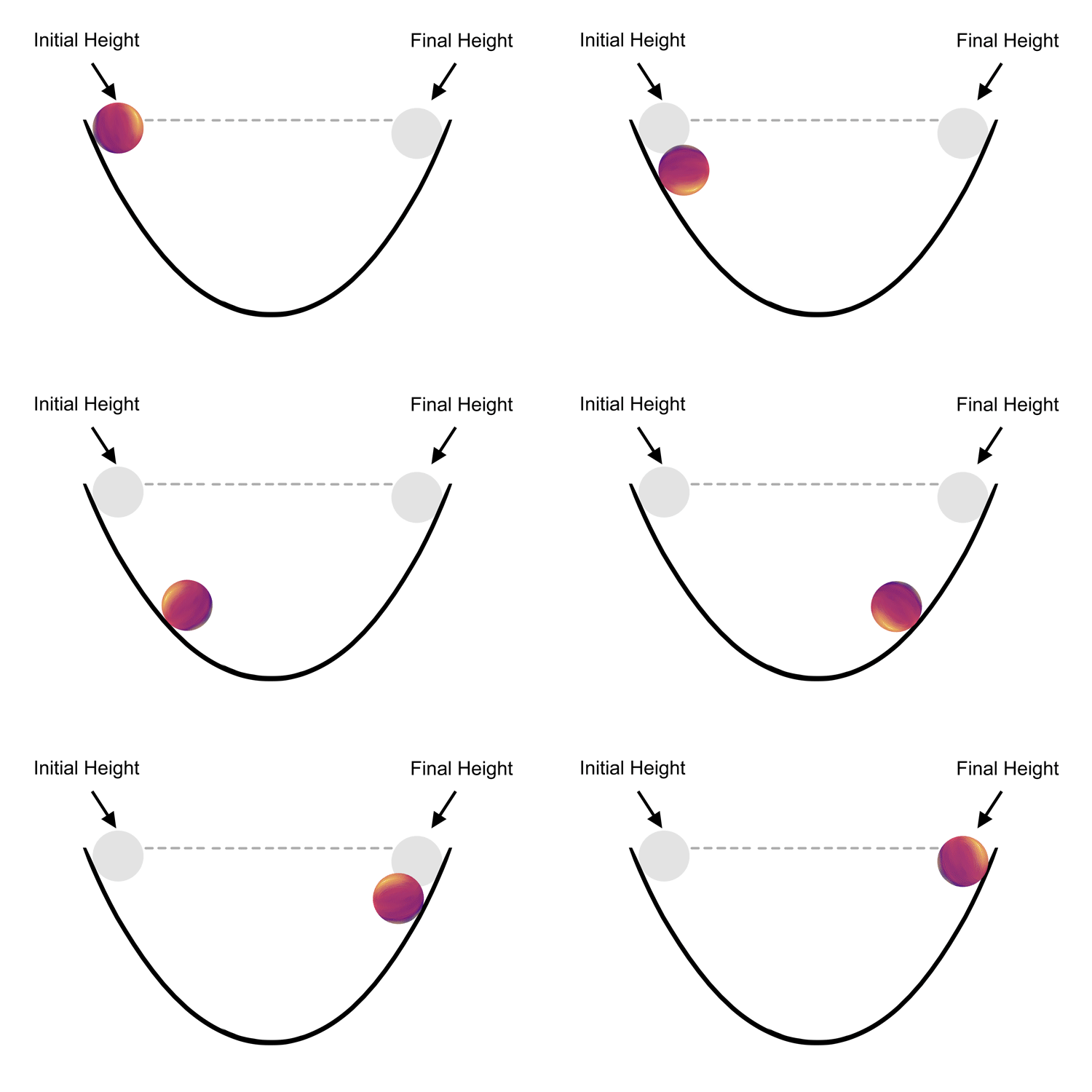
Galileo observed balls rolling down different curves.
The ball will run down one side of the curve then up the other. Galileo noticed that if smooth surfaces were used, the ball got closer to its original height (its height at the starting point). Galileo reasoned that the ball would get to the original height if there were no friction. The ball would get to the original height if there were no outside force (unbalanced force).
Regardless of the angles, the ball will always move towards its original height. If the incline of the second curve is less than that of the first, then the ball will travel a greater distance but still will not reach its original height due to friction – ie, the ball encountering resistance from the surface it is running along. Without friction, the ball would roll up the opposite slope to its original height even if the two ramps had different slopes.
With no friction a rolling ball will carry on forever.
Galileo concluded that if the curve ended with no incline then the ball would carry on forever were it not for friction eventually stopping it.

Newton used these observations to conclude that a force is not needed to keep an object in motion. It is in fact an external force that prevents the ball continuing.

What made Newton so radical was that before his first law of motion, scientists had said an object came to a stop because there was no force acting on it.

Newton’s First Law of Motion (Law of Inertia)
→ Any object remains in the state of rest or in uniform motion along a straight line, until it is compelled to change the state by applying external force.

Explanation: If any object is in the state of rest, then it will remain in rest until a external force is applied to change its state. Similarly, an object will remain in motion until any external force is applied over it to change its state.This means all objects resist to in changing their state. The state of any object can be changed by applying external forces only.

• Newton’s First Law of Motion in Everyday Life
(i) A person standing in a bus falls backward when bus starts moving suddenly.
→ This happens because the person and bus both are in rest while bus is not moving, but as the bus starts moving, the legs of the person start moving along with bus but rest portion of his body has the tendency to remain in rest. Because of this, the person falls backward; if he is not alert.

(ii) A person standing in a moving bus falls forward if driver applies brakes suddenly.
→ This happens because when bus is moving, the person standing in it is also in motion along with bus. But when driver applies brakes the speed of bus decreases suddenly or bus comes in the state of rest suddenly, in this condition the legs of the person which are in contact with the bus come in rest while the rest part of his body have the tendency to remain in motion. Because of this person falls forward if he is not alert.

(iii) Before hanging the wet clothes over laundry line, usually many jerks are given to the clothes to get them dried quickly. Because of jerks, droplets of water from the pores of the cloth falls on the ground and reduced amount of water in clothes dries them quickly.
→ This happens because when suddenly clothes are made in motion by giving jerks, the water droplets in it have the tendency to remain in rest and they are separated from clothes and fall on the ground.
(iv) When the pile of coin on the carom-board is hit by a striker, coin only at the bottom moves away leaving rest of the pile of coin at same place.
→ This happens because when the pile is struck with a striker, the coin at the bottom comes in motion while rest of the coin in the pile has the tendency to remain in the rest and they vertically falls the carom-board and remain at same place.

Mass and Inertia
→ The property of an object because of which it resists to get disturb its state is called inertia.
→ Inertia of an object is measured by its mass. Inertia is directly proportional to the mass. This means inertia increases with increase in mass and decreases with decrease in mass.
→ A heavy object will have more inertia than the lighter one. In other words, the natural tendency of an object that resists the change in state of motion or rest of the object is called inertia.
→ Since a heavy object has more inertia, thus it is difficult to push or pull a heavy box over the ground than the lighter one.

Momentum
→ Momentum is the power of motion of an object.
→ The product of velocity and mass is called the momentum. Momentum is denoted by ‘p’.
→ Therefore,  Momentum of the object = Mass × Velocity (p = m × v)
where, p = momentum, m = mass of the object and v = velocity of the object.

• Some explanations to understand the momentum:
→ A person get injured in the case of hitting by a moving object, such as stone, pebbles or anything because of momentum of the object.
→ Even a small bullet is able to kill a person when it is fired from a gun because of its momentum due to great velocity.
→ A person get injured severely when hit by a moving vehicle because of momentum of vehicle due to mass and velocity.

Momentum and Mass
→ Since momentum is the product of mass and velocity (p = m × v) of an object. This means momentum is directly proportional to mass and velocity. Momentum increases with increase of either mass or velocity of an object.
→ This means if a lighter and a heavier object is moving with same velocity, then heavier object will have more momentum than the lighter one.
→ If a small object is moving with great velocity, it has tremendous momentum. And because of momentum, it can harm an object more severely.
Example: a small bullet having a little mass even kills a person when it is fired from a gun.
→ Usually, road accidents prove more fatal because of high speed than in slower speed. This happens because vehicles running with high speed have greater momentum compared to a vehicle running with slower speed.

Momentum of an object which is in the state of rest
Let an object with mass ‘m’ is in the rest.Since, object is in rest, therefore, its velocity, v = 0
Now we know that,
Momentum = mass × velocity⇒ p = m × 0 = 0
Thus, the momentum of an object in the rest i.e. non-moving, is equal to zero.

Unit of momentum
→ SI unit of mass = kg
→ SI unit of velocity = m/s
We know that,Momentum (p) = m × v
∴ p = kg × m/s ⇒ p = kgm/s

Numerical Problems Based on Momentum
Type I: Calculation of Momentum
Example 1: What will be the momentum of a stone having mass of 10 kg when it is thrown with a velocity of 2 m/s?

Solution
Mass (m) = 10 kg
Velocity (v) = 2 m/s
We know that,
Momentum (p) = Mass (m) × Velocity (v)
∴ p = 10 kg × 2 m/s = 20 kg m/s
Thus, the momentum of the stone = 20 kg m/s.

Example 2: Calculate the momentum of a bullet of 25 g when it is fired from a gun with a velocity of 100 m/s.

Solution
Given,
Velocity of the bullet (v) = 100 m/s
Mass of the bullet (m) = 25 g = 25/1000 kg = 0.025 kg
Since, p = m × v∴ p = 0.025 × 100 = 2.5 kg m/s
Momentum of the bullet  = 2.5 kg m/s.

Example 3: Calculate the momentum of a bullet having mass of 25 g is thrown using hand with a velocity of 0.1 m/s.
Solution
Given,
Velocity of the bullet (v) = 0.1 m/s
Mass of the bullet (m) = 25 g = 25/1000 kg = 0.025 kg
Momentum (p) = Mass (m) × Velocity (v)
∴ p = 0.025 kg × 0.1 m/s⇒ p = 0.0025 kg m/s
Momentum of the bullet = 0.0025 kg m/s
Example 4: The mass of a goods lorry is 4000 kg and the mass of goods loaded on it is 20000 kg. If the lorry is moving with a velocity of 2 m/s, what will be its momentum?

Solution
Given,
Velocity (v) = 2 m/s
Mass of lorry = 4000 kg
Mass of goods on the lorry = 20000 kg
∴ Total mass (m) on the lorry = 4000 kg + 20000 kg = 24000 kg
Momentum (p) = Mass (m) × Velocity (v)
∴ p = 24000 kg × 2 m/s⇒ p = 48000 kg m/s
Momentum of the lorry = 48000 kg m/s.

Example 5: A car having mass of 1000 kg is moving with a velocity of 0.5 m/s. What will be its momentum?
Solution
Given,
Velocity of the car (v) = 0.5 m/s
Mass of the car (m) = 1000 kg
Momentum (p) = Mass (m) × Velocity (v)
∴ p = 1000 kg × 0.5 m/s = 500 kg m/s
Momentum of the car = 500 kg m/s.

Statement of Second Law of Motion
→ Rate of change of momentum of an object is proportional to applied unbalanced force in the direction of force.
Mathematical expression
Suppose,
Mass of an object = m kg
Initial velocity of an object = u m/s
Final velocity of an object = v m/s
∴ Initial momentum, p1 = mu
Final momentum, p2 = mv
∴ Change in momentum = Final momentum – Initial momentum
= mv – mu
= m(v – u)
∴ Rate of change of momentum = Change in momentum/Time taken
= m(v-u)/t
•  According to 2nd law, this rate of change is momentum is directly proportional to force.

We know that, a = (v-u)/t (From 1st equation of motion)
∴ F = kma
where, k is a constant. Its value can be assumed as 1.
∴ F = 1 × m × a = ma
• SI unit = kg m/s 2 or Newton
1 Newton: When an acceleration of 1 m/s2 is seen in a body of mass 1 kg, then theforce applied on the body is said to be 1 Newton.

Proof of Newton’s First Law of Motion from Second Law

→ First law states that if external force F = 0, then a moving body keeps moving with the same velocity, or a body at rest continues to be at rest.
∴ F = 0
We know, F = m(v-u)/t
(i) A body is moving with initial velocity u then,
m(v-u)/t = 0 ⇒ v – u = 0
∴ v = u
Thus, final velocity is also same.
(ii) A body is at rest i.e., u = 0
Therefore, from above u = v = 0
So, the body will continue to be at rest.

Third Law of Motion
→ For every action there is an equal an opposite reaction.

Applications

(i) Walking is enabled by 3rd law.
(ii) A boat moves back when we deboard it.
(iii) A gun recoils.
(iv) Rowing of a boat.

Law of Conservation of Momentum

→ When two (or more) bodies act upon one another, their total momentum remains constant (or conserved) provided no external forces are acting.

• Initial momentum = Final momentum

Suppose, two objects A and B each of mass m1 and mass m2 are moving initially with velocities u1 and u2, strike each other after time t and start moving with velocities v1 and v2 respectively.


Now,
Initial momentum of object A = m1u1
Initial momentum of object B = m2u2
Final momentum of object A = m1v1
Final momentum of object B = m2v2
So,
Rate of change of momentum in A,
F1 = (m1v1 - m1u1)t = m1(v1 - u1)/t  ....(i)

Rate of change of momentum in B,
F2 = (m2v2 - m2u2)t =  m2(v2 - u2)/t  ....(ii)
We know from 3rd law of motion,
F1 = −F2
So, m1(v1 - u1)/t = -m2(v2 - u2)/t
⇒ m1v1 – m2u2 = −m2v2 + m1u1
⇒ m1u1 + m2u2 = m1v1 + m2v2
Thus, Initial momentum = Final momentum

Example 1: A bullet of mass 20 g is fired horizontally with a velocity of 150 m/s from a pistol of mass 2 kg. Find the recoil velocity of the pistol.
Solution

Given,
Mass (m1) of bullet = 20 g = 0.02 kg
Mass (m2) of pistol = 2 kg
Initially bullet is inside the gun and it is not moving.
∵ Mass = m1+m2 = (0.02 + 2) kg = 2.02 kgand u1 = 0
∴ Initial momentum = 2.02 × 0 = 0  ....(i)
Let the velocity of pistol be v2 and v1 for bullet = 150
∴ Final momentum = m1v1 + m2v2 = 0.02×150 + 2v2 ...(ii)
We know that,
Initial momentum = Final momentum
∴ (0.02×150)/100 + 2v2 = 0   [From equations (i) and (ii)]
⇒ 3 + 2v2 = 0
⇒ 2v2 = −3
⇒ v2 = −1.5 m/s
(−)ve sign indicates that gun recoils in direction opposite to that of the bullet.

Example 2: Two hockey players viz A of mass 50 kg is moving with a velocity of 4 m/s and another one B belonging to opposite team with mass 60 kg is moving with 3 m/s, get entangled while chasing and fall down. Find the velocity with which they fall down and in which direction?

Solution


Given,

mA = 50 kg, uA = 4 m/s

mB = 60 kg, uB = 3 m/s

Initial momentum A = mAuA = 50 × 4 = 200 kgm/s

Initial momentum B = mBuB = 60 × 3 = 180 kgm/s

∴ Total initial momentum = 200 + 180 = 380 kgm/s ....(i)

Final momentum = (mA + mB)v = (50 + 60)v = 110v  ....(ii)

According to the law of conservation of momentum,

380  = 110v

⇒ v = 380/110 = 3.454 m/s 


Sunday, 4 September 2022

Class 9 Science Chapter 1 Matter in our surroundings


Class 9 Science

Chapter 1 Matter in our surroundings

Introduction

→ Since early times human beings have been trying to understand their nature. Early Indian  philosopher classified matter into five basic elements. the“Panch Tatva”– air, earth, fire, sky and water. According to them, living as well as non living things are made up  of these elements.

→ Now a days, scientists evolved to types of classification of matter – physical properties and chemical nature.

Physical Nature of Matter

→  Matter is made up of particles. All matter constitute of very small particles. These small particles are called atoms.

→ These particles of matter are too small so they cannot be seen by naked eyes or simple microscope.

→ Particles of matter are continuously moving as they posses kinetic energy, with the increase of temperature kinetic energy of particles also increases so particle moves faster.

Diffusion

→ Brownian Motion: The zig-zag or random path travelled by the particles of matter is called Brownian motion.


→  Intermixing of particles of two different types of matter on their own is called diffusion. The rate of diffusion increases on increasing the temperature of the diffusing substance (by heating). It is natural process. It takes place in solid, liquid and gas.

Characteristics of Particles of Matter

• Particles of matter have space between them
→ Gas can be compressed a lot because of the space between their particles.
→ When sugar is dissolved in water, the particles of sugar disappear in water. This happens because particles of sugar get adjusted in the spaces between the particles of water. Additionally you will notice that there is no rise of water level takes place when one or two teaspoon of sugar is added in a glass of water, this is because sugar particles get adjusted in the space between the particles of water and no rise in the water level comes in result.

• Particles of matter attract each other because of force of attraction
→ Force of attraction between particles of matter keeps the particles bonded together. The force of attraction between particles of solid is greatest, between particles of liquid is moderate and between particles of gas is lowest.
→ Because of the lowest force of attraction between the particles of gas we can move our hand through air easily. To move our hand in liquid, such as water, we have to apply some force, but from a solid such as wood, we cannot move our hand.
→This is because the force of attraction between particles of gas is almost negligible, in liquid the forces of attraction is moderate but it is greatest in solid.
→ The force of attraction between particles of solid, liquid and gas can be arranged in decreasing order as follows:Solid > Liquid > Gas

States of Matter
• Solid State

→ The space between the particles is very less.
→ The force of attraction between the particles is strong. Thus, particles in a solid are closely packed.
→ Solids maintain their shape even when they are subjected to external force i.e. they are rigid.
→ Solids cannot be compressed.
→ The kinetic energy of the particles is very less and so solids have an orderly arrangement of the particles.Therefore, solids have a fixed shape and volume.

• Liquid State
→  The space between the particles is slightly more as compared to solids, but still very less as compared to gases. The particles of a liquid can slip and slide over each other.
→ The force of attraction between the particles is strong enough to hold the particles together but not strong enough to hold the particles in a fixed position.
→ Liquids do not have a fixed shape but have a fixed volume. Liquids take up the shape of the container in which they are poured.
→ The kinetic energy of the particles is more than that of solids. Thus, liquids have a disorderly arrangement of particles compared to solids.
→ Liquids cannot be compressed much. The compressibility of liquids is almost negligible.

• Gaseous State
→ The particles are much farther apart from one another as compared to solids and liquids.They have a very disorderly arrangement of particles compared to the solids and liquids.
→ The force of attraction between the particles is negligible, hence particles of a gas move freely in all the directions. Gases thus can mix or diffuse into other gases.
→ The particles of a gas have maximum kinetic energy. They move with high speed in all directions and can exert pressure on the walls of its container.
→ Gases neither have a definite shape nor a definite volume.They fill up the container completely.
→ Gases can be compressed easily. Example: the LPG cylinders used at home and the CNG cylinders used in vehicles.

Change of State of Matter

→ The phenomenon of change from one state of matter to another, and then back to the original state is called the interconversion of states of matter.

→ Matter Can Change its State. Water can exist in three states of matter:

• Solid as ice

• Liquid as water

• Gas as water vapour

Effect of Temperature

→ On increasing the temperature of solids, the kinetic energy of the particles increases which overcomes the forces of attraction between the particles thereby solid melts and is converted to a liquid.

→ The temperature at which a solid melts to become a liquid at the atmospheric pressure is called its melting point. The melting point of ice is 273.16 K.

The process of melting, that is, change of solid state into liquid state is also known as fusion.

• Latent heat

The hidden heat which breaks the force of attraction between the molecules is known as the latent heat. Since, the heat energy is hidden in the bulk of the matter, it is called latent heat.

• Latent heat of fusion

→ The heat energy required to convert 1 kilogram of a solid into liquid at atmospheric pressure, at its melting point, is known as the latent heat of fusion.

→ The temperature at which a liquid starts boiling, at atmospheric pressure, is called its boiling point.

→ Boiling is a bulk phenomenon. Particles from the bulk of the liquid gain energy to change into the gaseous state. For example, boiling point of water is 100° C. (or 100° C = 273 + 100 = 373 K)

• Latent heat of vaporisation

→ The heat energy required to convert 1 kilogram of liquid into gas, at atmospheric pressure, at its boiling point, is known as the latent heat of vaporisation

→ The process, in which a gas, on cooling, turns into a liquid at a specific temperature is called condensation or liquefaction. Formation of clouds is due to the condensation of water vapour from the Earth’s surface.

→ The change of state of a substance directly from a solid to gas, without changing into the liquid state (or vice versa) is called sublimation.

→ The temperature at which the state of a substance changes from a liquid to a solid is called the freezing point of that substance.


→ When a solid melts, its temperature remains the same because heat gets used up in changing thestate by overcoming the forces of attraction between the particles. It is considered that it getshidden into the contents of the beaker and is known as the latent heat.

→ Water vapour at 373 K have more energy than water at the same temperature because

Effect of change of pressure

→ Gases can be liquefied by applying pressure and reducing the temperature. When a high pressure is applied to a gas, it gets compressed and if the temperature is lowered, the gas is liquefied.

→ Solid CO2 gets converted directly to gaseous state on decrease of pressure to 1 atmosphere without coming into liquid state. This is the reason that solid carbon dioxide is also known as dry ice.

Evaporation

→ The process of conversion of a substance from the liquid state to the gaseous state at any temperature below its boiling point is called evaporation or vaporisation.

→ Evaporation is a surface phenomenon.

• Factors affecting the rate of evaporation

→ The rate of evaporation increases on increasing the surface area of the liquid.

→ The rate of evaporation increases with an increase in temperature.

→ Decrease in the humidity increases the rate of evaporation.

→ An increase in the wind speed increases the rate of evaporation.

• Evaporation causes cooling

→ The particles of liquid absorb energy from the surrounding to regain the energy lost during evaporation. This absorption of energy from the surroundings make the surroundings cold.

→ Lately, scientists are talking about five states of matter or five phases of matter. These are-solids, liquids, gases, plasmas and the Bose–Einstein condensate.

Plasma

The state consists of super energetic and super excited particles. These particles are in the form of ionised gases. The fluorescent tube and neon sign bulbs consist of plasma.

Bose-Einstein Condensate

→ Indian physicist Satyendra Nath Bose made a study regarding the fifth state of matter. Based on his study, Albert Einstein predicted a fifth state of matter called the Bose-Einstein Condensate.

→ The Bose-Einstein Condensate or BEC is formed by cooling a gas of extremely low density to super low temperatures.

Some Important Measurements

→ The SI unit of mass is kilogram (kg).

→ The SI unit of volume is cubic metre (m3). The common unit of measuring volume is litre (L) such that 1L = 1 dm3, 1L = 1000 mL, 1 mL = 1 cm3.

→ Kelvin is the SI unit of temperature, 0° C = 273.16 K. For convenience, we take 0° C = 273 K after rounding off the decimal. To change a temperature on the Kelvin scale to the Celsius scaleyou have to subtract 273 from the given temperature, and to convert a temperature on the Celsius scale to the Kelvin scale you have to add 273 to the given temperature.

→ Atmosphere (atm) is a unit of measuring pressure exerted by a gas. The unit of pressure is Pascal (Pa): 1 atmosphere = 101325 Pa. The pressure of air in atmosphere is called atmospheric pressure. The atmospheric pressure at sea level is 1 atmosphere, and is taken as the normal atmospheric pressure.


Glass 10 Science Chapter 11 Human eye and Colourful world

Glass 10 Science

Chapter 11 Human eye and Colourful world 

Introduction

→ Human eye: The sense organ that helps us to see.

→ Located in eye sockets in skull.

→ Diameter of eye ball – 2.3 cm.

Parts of Human Eye

• Cornea: It is the outermost, transparent part. It provides most of the refraction of light.

• Lens: It is composed of a fibrous, jelly like material. Provides the focused real and inverted image of the object on the retina. This is convex lens that converges light at retina.

• Iris: It is a dark muscular diaphragm that controls the size of the pupil.

• Pupil: It is the window of the eye. It is the central aperture in iris. It regulates and controls the amount of light entering the eye.

• Retina: It is a delicate membrane having enormous number of light sensitive cells.

• Far point: The maximum distance at which object can be seen clearly is far point of the eye. For a normal adult eye, its value is infinity.

Near point or Least distance of distinct vision

→ The minimum distance at which objects can be seen most distinctively without strain.

→ For a normal adult eye, its value is 25 cm.

→ Range of human vision – 25 cm to infinity.

• Accomodation: The ability of the eye lens to adjust its focal length is called accommodation. Focal length can be changed with the help of ciliary muscles.

→ Focal length increases when Ciliary muscles get relaxed and lens get thin.

→ Focal length decreases when Ciliary muscles get contract and lens get thick.

Myopia (Near sightedness)

→ A myopic person can see nearby objects clearly but cannot see distant objects clearly.

→ Image is formed in front of retina.

Causes of Myopia

→ Excessive curvature of eye lens.

→ Elongation of eye ball

Correction of Myopia

→ It is done by using concave lens of appropriate power.

(i) In a myopic eye, image of distant object is formed in front of the retina. (and not on the retina)


(ii) The far point (F) of a myopic eye is less than infinity.


(iii) Correction of myopia. The concave lens placed in front of the eye forms a virtual image of distant object at far point (F) of the myopic eye.


Hypermetropia (Far sightedness)
→ Affected person can see far objects clearly but cannot see nearby objects clearly.
→ The near point of the eye moves away.
→ Image is formed behind the retina.

Causes of Hypermetropia
→ Focal length of the eye lens becomes too long.
→ Eye ball becomes too small.

Correction of Hypermetropia
→ Use of convex lens of suitable power can correct the defect.


Presbyopia (Old age Hypermetropia)

→ It is the defect of vision due to which an old person cannot see the nearby objects clearly due to loss of power of accomodation of the eye.

→ The near-point of the old person having presbyopia gradually recedes and becomes much more than 25 cm away.

Causes of Presbyopia

→ Gradual weakening of ciliary muscles.

→ Diminishing flexibility of eye lens.

Correction of Presbyopia

→ Use of convex lens of suitable power.

→ Sometimes a person may suffer from both myopia and hypermetropia.

→ Such people require bifocal lens for correction.

Advantage of the eyes in front of the face

→ It gives a wider field of view.

→ It enhances the ability to detect faint objects.

→ It provides three dimensional view.

Refraction through a glass prism

• Prism: It is a pyramidal piece of glass with two triangular bases and three rectangular lateral surfaces.

• Angle of Prism: The angle between two adjoining lateral surfaces. Refraction through a glass prism.

Angle of deviation (d): It is the angle between incident ray and emergent ray.


→ When white light is passed through a glass prism, it splits into its seven constituent colours to form a band of seven colours. This phenomenon is called dispersion.

• Spectrum: The band of seven colours formed due to dispersion of white light is called spectrum.

• Acronym: It is a group of alphabets that represent sequential colours in spectrum.V I B G Y O R

→ Angle of deviation ∝ 1/wavelength

→ Red is the least deviated colour as it has largest/longest wavelength.

→ Violet is the most deviated colour as it has smallest wavelength in visible spectrum.

→ Issac Newton was the first person who proved that sunlight is made up of seven colours :

(i)  He passed sunlight through a glass prism to form a band of seven colours.

(ii) He tried to split the colours further by putting another prism ahead of the prism forming spectrum but he failed to obtain more colours.

(iii) He formed a spectrum from sunlight and placed an identical but inverted prism in front of prism forming the spectrum. All the seven colours combined by the inverted prism and emerged as white light.

Total Internal Reflection

→ When light enters obliquely from a denser medium to a rarer medium and the angle of incidence exceeds critical angle, the light reflects in the denser medium. This is called internal reflection.

Conditions necessary for Internal Reflection

→ Light should enter obliquely from a denser to a rarer medium.

→ The angle of incidence should exceed critical angle, the light reflects in the denser medium.

• Critical angle: The angle of incidence for which the angle of refraction is 90ยบ.

• Rainbow: It is a natural spectrum appearing in the sky after rain showers. Rainbow is observed in the direction opposite to the sun.


• Three phenomenon which are involved in rainbow formation are :
(i) Dispersion
(ii) Refraction
(iii) Internal reflection
→ Some water droplets remain suspended in air after rain. These droplets behave as glass prism.
 →  When light enters the rain drop, it first refracts and disperses.
→ Then it reflects internally and again refracts as it come out of the drop and the seven colours reach the eye of observer in form of rainbow.

• Atmospheric Refraction: The refraction by different layers of atmosphere is called atmospheric refraction.
(i)  Apparent flickering of objects placed behind a hot object or fire.
(ii) Stars near the horizon appear slightly higher than their actual position.
(iii) Advanced sunrise and delayed sunset.
(iv) Apparent flattering of sun’s disc.
(v) Twinkling of stars.

(i)  An object placed behind the fire or a hot surface appears to flicker when seen through the air.
→ The air above hot surface becomes hot and rises. The space is occupied by cool air. The refractive index of hot air is less than that of cool air.
→ So, the physical condition of the medium are not constant.
→ Due to changing Refractive Index (RI) of medium, the light appears to come from different directions.
→ It results in fluctuation in apparent position of object.

(ii) Stars when seen near the horizon appear slightly higher than their actual position due to atmospheric refraction.


→ The refractive index of earth’s atmosphere in general increases from top to bottom.

→ So, the light coming from a star near the horizon has to travel from rarer to denser medium and it bends towards the normal.

→ As a result the star appears higher.

(iii) Advanced sunrise


→  The sun appears about two minutes earlier than actual sunrise and the sun remains visible for about two minutes after actual sunset.

→ When the sun is below horizon, the rays have to pass from rarer to denser medium.

→  So rays bend towards the normal. As a result the sun appears higher than its actual position.

(iv) Twinkling of stars

→ Stars are very far from us, so they behave as point source of light.

→ Since the physical conditions of the earth’s atmosphere are not constant the light fromstars appears to come from different directions.

→ This results in fluctuation of apparent position of star.

→ The amount of light coming from stars also vary due to changing Refractive Index of atmosphere.

→ The star appears bright when more light from star reaches our eyes and the same star appears dull when less amount of light reaches our eyes.

→ Both these effects are responsible for twinkling of stars.

Scattering effect

Spreading of light in various directions by colloid particles.

Scattering ∝ 1/wavelength

• Tyndall effect: When light passes through a colloid its path becomes visible. This is called Tyndall effect.

Example:

(i) Path of light becomes visible when light enters a dark and dusty room through a slit or ventilator.

(ii) Path of light becomes visible when light passes through dense canopy of trees in a forest.


Dependence of colour of scattered light

(i) If particles are very fine, they scatter mainly the blue colour of light (shorter wavelength).

(ii) Medium sized particles scatter mainly the red colour (longer wavelength).

(iii) Even larger particles scatter all the colours of light that is why it appears white.
→ Wavelength of red light is about 1.8 times to that of blue light.

• Anger signs are made in red colour
→ Red is the least scattered colour. It is least scattered by fog and smoke and can be seen in the same colour over a long distance. So, danger signs are made in red colour.

• Colour of sky appears blue on a clear day
The upper layer of atmosphere contains very fine particles of water vapours and gases. These particles are more effective in scattering of light of shorter wavelength mainly blue than larger wavelength. So, the sky appears blue

• Appearance of sky to an astronaut in the space

→ The sky would appear dark to an astronaut in the space as scattering is not very prominent at such high altitude due to absence of particles.

• Clouds appear white
→ Clouds are formed by water vapours. Water vapours condense to form water droplets due to larger size of droplets, all colours of light are scattered and clouds appear white.

• Colour of sun appear red during sunrise and sunset

→ While sunset and sunrise, the colour of the sun and its surrounding appear red. During sunset and sunrise, the sun is near horizon and therefore the sunlight has to travel larger distance in

Due to this most of the blue light (shorter wavelength) are scattered away by the particles. The light of longer wavelength (red colour) will reach our eye. This is why sun appear red in colour.